
You Can Do It Too
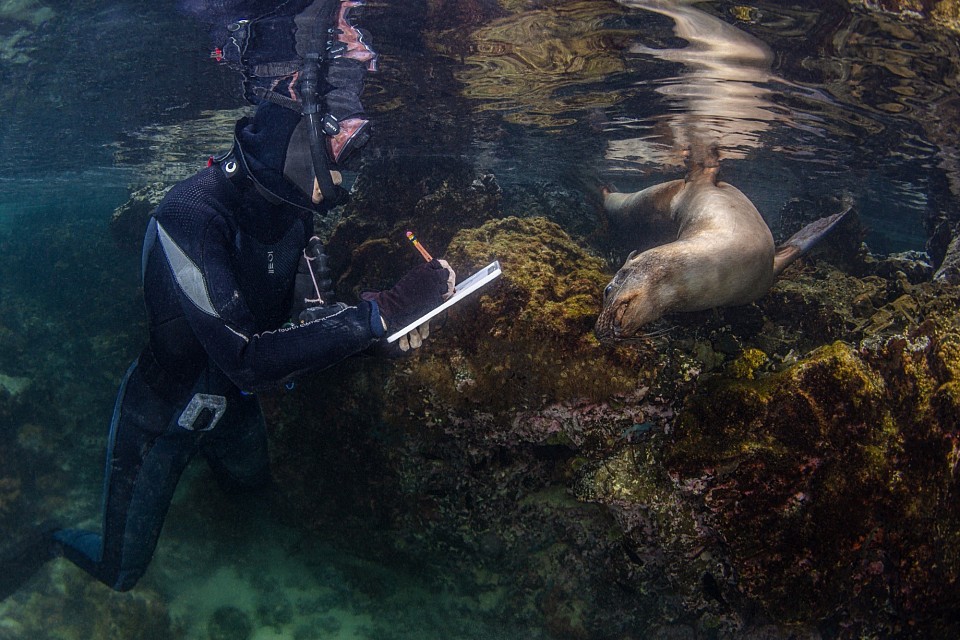
Jay Sketching a Sea-Lion image by Dan Shipp
SKETCHING SEA LIONS IN THE GALAPAGOS ISLANDS
By Jay Shipp
How do you sketch a sea lion underwater? Well, it's not easy! They move fast! They are undeniably one of the most efficient movers in the ocean. Their low drag builds, propelled by powerful fore flippers, allow these stealthy creatures to perform a hydrodynamic ballet of agility, speed, and efficiency. Patience is your ace card, of course, but being in the right place at the right time helps, too! The Galapagos Islands are one of those places at any time!
The Galapagos sea lion is a curious creature. Especially the young ones! They're also extremely playful! Add a dash of audience participation, a human, and you have the makings of an entertaining snorkel or dive. Props seem to be an essential element, too! Especially the bubbles exhaled by the scuba diver's regulators. These bubbles tend to send the Galapagos sea lion fraternity into an exhilarated frenzy!
So you've got your curious sea lion right up close. Waterproof sketchbook at the ready - perfect! They've even brought their toys to amuse themselves - a starfish, rocks, and an understandably grumpy marine iguana hanging by the tail from the sea lion's mouth. The problem is, they've now decided to take it up a notch and are moving even faster! It's playtime, and you are almost certainly part of their game plan. One sea lion, toy in mouth, swims to the surface and releases the object or animal. At the same time, the others wait with great anticipation. A sudden burst of pirouetting bodies descends, chasing the object down. The human, that was me, was inevitably left behind, like the youngest child amongst a group of children playing tag. I watch the turmoil below, hoping they will return as I need to make those last few pencil marks in my sketchbook. I wait, and there, I spot them. The winner ascends with the recovered object, shrouded by playful escorts. I might add that, at this point, the marine iguana has escaped with its tail intact. A little ruffled but otherwise unharmed.
So, after two hours in the water, I finally finished my sketches and enjoyed every moment of the process. The sea lions were, of course, in complete control of the whole experience. I certainly would never chase after a wild animal. Neither would I touch them. They are wild creatures and need to be respected as such. Many of the creatures of the Galapagos Islands have learnt to trust humans, an unsurprisingly rare behaviour. This unique gem, the Galapagos Archipelago, is a large protected marine park where wildlife can live in the company of humans without fear.
WHICH ISLAND IS BEST TO SEE SEA LIONS?
Sea lions can be found on almost all of the Galapagos archipelago islands. They practically own the place! That's not an exaggeration! You'll find them in the water, on the beach, occupying most available benches, and stretched across the roads. Everyone has to move around them, including the local transport. San Cristobal is where I spent most of my time sketching these lovable creatures. It is the easternmost island in the archipelago and one of the oldest. It is also home to one of the largest populations of sea lions. Young sea lions are particularly interested in people. These youngsters drive most water-based interactions as they are playful and extremely curious.
WATER CONDITIONS
A combination of five converging water currents influences the biodiversity of the Galapagos Islands. One of them, the Humboldt Current, flows from Antarctica. It's cold! The endemic wildlife has adapted to this temperature, but a 5mm wetsuit is advisable if you intend to stay in the water for long periods or, like me, feel the cold.
ON LAND
If you don't want to spend most of your time in the water, the beach is also a good option for sea lion watching, especially during the breeding season. It starts around June and ends in December. In San Cristobal, October to December is the best time to visit, as this is when the highest proportion of babies are born. These newborns are adorable! They stay mainly on the beach for the first five weeks, and then, once they have moulted, they start dipping their flippers into the ocean and learning how to swim and catch fish.
GETTING THERE
To get to the Galapagos Islands, you must first travel to Ecuador. There are two international airports in Ecuador, Quito UIO and Guayaquil GYE. Direct flights from both cities depart daily for San Cristobal in the Galápagos Islands.
BEAR WATCHING IN TORFINO, CANADA
By Jay Shipp
We donned our Mustang floater suits and headed from the adventure store to Torfino’s waterfront, where our boat awaited. As we crossed to the jetty, two raccoons scurried across the harbour wall, briefly glancing at our party of four before returning to their food search. John, our guide and boat captain, handed us our life jackets as we boarded the tour vessel—an open boat with a powerful outboard engine. Our shared goal was to embark on a bear-watching adventure!
We settled into our seats while John, a trained naturalist, began to provide us with realistic expectations of our encounter. He maintained an optimistic outlook, as another boat had encountered a bear earlier that morning. I felt a sense of relief, considering it was still quite early in the season, and there was a chance we might not encounter one. However, mild winter conditions had stirred some bears from their deep torpor, making it more likely that we would see one. John explained that the bear spotted earlier that morning was likely a male. It was the first week of April, and females usually emerge from their dens with their cubs in May.
Our boat glided effortlessly across the mirror-like waters of the Clayoquot Sound, passing small, cloud-shrouded, forested islands along the way. John’s keen eyes scanned the horizon and rocky beaches as we ventured further. He spotted a bald eagle soaring above us and slowed the boat down. The eagle crossed our path and settled on the top of a towering pine. John’s passion for these majestic birds was infectious, and I developed a newfound respect for them as he shared his knowledge. He told us that Bald eagles hold deep spiritual significance for the indigenous peoples of North America, and are associated with vision, healing, and power. To our delight, a smaller second eagle landed nearby to the first one. Their eerie calls pierced through the cold morning air, adding a mystical aura to the experience.
As we ventured further, a large group of sea otters, collectively known as a raft, floated past us. They bobbed gracefully on their backs, some balancing on rocks that served as tools for cracking open their prey. John estimated that the raft consisted of approximately one hundred individuals. He explained that it would have been rare to encounter a sea otter a few years ago, due to the high demand for their pelts. Fortunately, a successful reintroduction program, coupled with the otters being granted protective status, has allowed them to thrive in the area once again.
Time seemed to flow effortlessly as we explored the sound, and I had almost forgotten our tour’s purpose: bear spotting. The captivating landscape and wildlife had already captured my heart, but the pièce de résistance was just around the next corner. A black dot against a honey-bouldered shoreline. As we drew nearer, the form of a black bear became apparent, eliciting widespread delight. John cut the boat engine, and we floated on the glassy water, maintaining a respectful distance from the bear. We watched in silence, careful not to disturb the powerful creature as he effortlessly rolled hefty rocks aside in search of crabs, a regular food source for the Vancouver Island Black Bear. His dark coat shone in the sunlight, a testament to his healthy condition. It was evident that he had fared well during the winter in his underground den. Scarface was his name, and he was the first bear I had encountered in a natural environment, rather than a zoo. My fellow passengers took photos, and I followed suit; this was an encounter worth recording! An hour passed before Scarface scaled the rocky shore and headed towards the tree line. He paused momentarily to look our way before disappearing into a forest of pine. It was a perfect end to a spellbinding morning. We set off for home with big smiles on our faces. The sun was climbing high, and the mist had now relinquished its hold on the rainforest-clad Mears Island, welcoming us back to the Tofino harbour.
For those seeking a connection with a Canadian wild bear, there’s perhaps no better way to observe these incredible creatures than from a boat in the tranquil waters of the Clayoquot Sound. What a place, what a day!
GETTING THERE
To reach Tofino, a coastal town on Vancouver Island, you’ll first need to cross the Strait of Georgia. BC Ferries serves as the primary link between the mainland and Vancouver Island.
FERRY
The ferry terminals are situated in Tsawwassen (south of Vancouver) and Horseshoe Bay (north of Vancouver). Numerous daily sailings are available. The ferry ride typically takes around 1.5 to 2 hours, depending on your mainland destination and the ferry route. It’s advisable to book your ferry tickets in advance, especially during peak travel periods or holiday weekends. The ferries can accommodate foot passengers and cars. If you don’t have a car, car rental companies are conveniently located in Nanaimo and Victoria.
From Nanaimo, head north on Highway 19 until you reach the turnoff for the scenic Highway 4. This stretch of 170 km (106 mi) offers breathtaking views through the mountainous rainforest. You can make several stops along the way to Tofino.
Alternatively, from Victoria, take Highway 1 (North) and merge onto Highway 19 (North). Take Exit 60 and merge onto Highway 4 (West). A well-marked junction will guide you north to Tofino.
SEAPLANE
Traveling by seaplane from Vancouver to Vancouver Island offers a unique and scenic experience, bypassing the ferry and providing a faster and more direct route with breathtaking views of the coastline and islands. Several seaplane companies, including Harbour Air Seaplanes, Sunshine Coast Air, and Seair Seaplanes, regularly schedule flights to Vancouver Island from the mainland.
Here are the directions from Nanaimo or Victoria Ferry Terminals:
From Nanaimo Ferry Terminal: Head north on Highway 19 until you reach the turnoff for scenic Highway 4. This stretch of 170 km (106 mi) is a pristine, curvy road through the mountainous rainforest. You can make several stops along the way to Tofino and back.
From Victoria Ferry Terminal: Take Highway 1 north and merge onto Highway 19 north. Take Exit 60 and merge onto Highway 4 west. A well-marked junction leads north to Tofino.
WEBSITE ADDRESSES
BC Ferries website: Ferry ticket bookings.
Booking.com: Accommodations bookings.
bear-watching Tour Company: We used this company, Tofino Whale Centre, but there are several others in Tofino that offer similar experiences.
Budget.com: Car rental company. They picked us up from the ferry terminal, which was very convenient.
Seaplane Bookings:
harbourair.com
Seaairseaplanes.com
sunshinecoastair.com
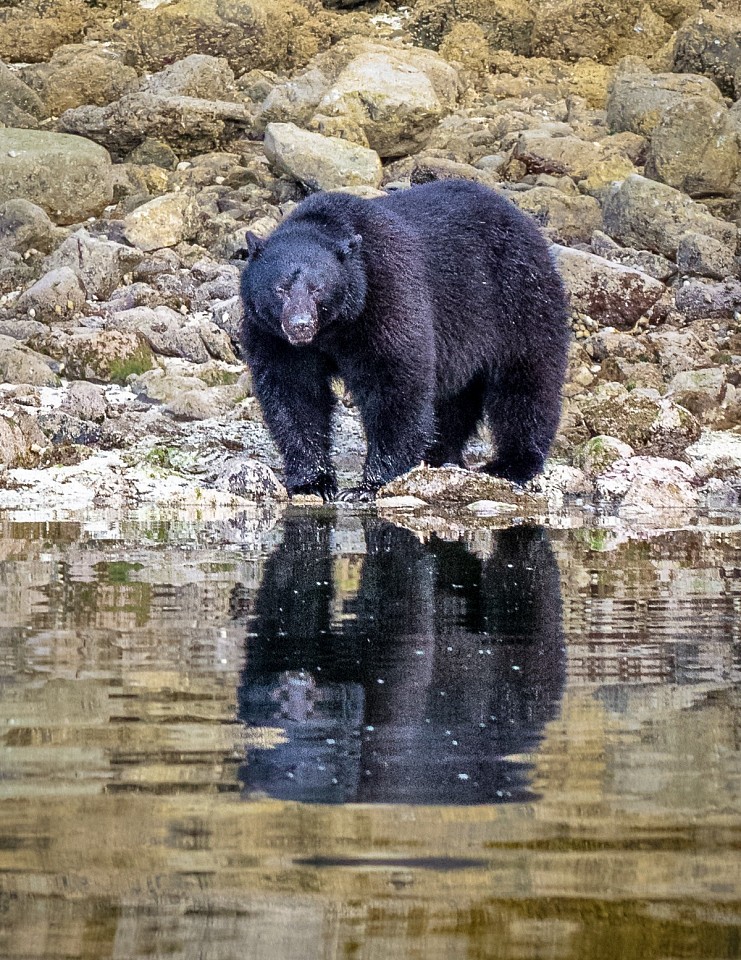
Scarface by Dan Shipp
It was time to shed our fins and don our hiking boots. We were trading the azure ocean for the lush forest green of an Ecuadorian cloud forest! That was the plan. We had just spent the past two months exploring the breathtaking Galápagos Islands, but our visas had expired, so it was time to embark on a new adventure. Exploring an Ecuadorian cloud forest, cushioning the disappointment of leaving the Galápagos Archipelago. Hummingbirds, singing frogs, toucans, and the iconic brightly coloured Andean Cock-of-the-Rock awaited us, we fervently hoped! Perhaps even a spectacled bear!
We stored our dive gear in Quito and set off by bus towards the Mindo Valley, nestled on the western slopes of the Andes. Waterfalls cascaded abundantly here, and so did some of the most delectable South American chocolate! A local delicacy that I particularly relish! Surrounding oneself in an environment teeming with trees is undoubtedly therapeutic, and cloud forests hold a special place in my heart. These forests are shrouded in perpetual clouds, which might sound gloomy, but these mystical environments are far from it! They are teeming with lush green vegetation that pierces the cloud line as the rainforest stretches upward towards the mountain peaks. Moisture-laden cloud banks roll off the ocean, drenching flora and fauna with life-giving water. This process, in turn, creates a rich ecosystem brimming with plant and animal biodiversity. The rewards are abundant. In this environment, nature doesn’t hold back. A vibrant tapestry of diverse life flourishes, with animal species filling every conceivable niche. Plants like epiphytes, such as orchids, mosses, and lichens, thrive by growing on other plants, efficiently utilising space, support, and positioning. Reconnecting with nature was going to be the inherent part of this experience.
We decided to commence our hike at the Yellow House Lodge. The trail here is privately owned and accessible to paying guests as part of their experience, as well as to visitors for a modest fee. To kick off our day, we enjoyed a delectable breakfast, prepared by the friendly staff, while hummingbirds gracefully flitted from the nectar feeders hanging in front of our table. It was an ideal beginning to our hiking escapade.